8 October 2026 · 3 min read
Sales Follow-Up Tracker: A Simple Way to Stop Deals Going Cold
Learn how to build a sales follow-up tracker that keeps every deal moving, assigns ownership, and prevents promising opportunities from being forgotten.
Overview
Most sales deals do not disappear because the prospect said no.
They disappear because nobody followed up at the right time.
A prospect asks for more information. A founder promises to send a proposal. A customer says to check back after a board meeting. Someone takes notes, intends to respond, and then the next urgent task takes over.
A sales follow-up tracker creates one clear place to answer:
• Which deals need a follow-up?
• Who owns the next action?
• What was promised?
• When should it happen?
• Which opportunities are becoming risky?
What is a sales follow-up tracker?
A sales follow-up tracker is a system for managing the actions required to move opportunities forward.
It can begin as a spreadsheet, but it becomes more useful when it connects follow-ups to the relevant contact, company, deal stage, notes, and previous conversations.
At a minimum, track:
Field — What it tells you
Company — Which account the action belongs to
Contact — Who needs a response
Deal value — Why the opportunity matters
Deal stage — Where the opportunity sits in the sales process
Last interaction — When the prospect was last contacted
Next action — What should happen next
Owner — Who is responsible
Due date — When the action needs to happen
Status — Whether the follow-up is open, complete, or blocked
The most important field is next action. Every active deal should have one.
Why follow-ups get missed
Small teams often manage sales across several places:
• CRM records
• Email inboxes
• Slack messages
• Call notes
• Spreadsheets
• Personal to-do lists
• Calendar reminders
That setup works until there are enough active conversations that memory is no longer reliable.
A follow-up tracker prevents a common mistake: assuming that because a deal exists in the pipeline, someone is actively moving it forward.
A deal without a next action is not an active deal. It is a possibility waiting to be forgotten.
How to write better follow-up tasks
Avoid vague tasks such as:
• Follow up with prospect
• Check in with customer
• Send information
• Revisit next week
Write a specific action instead:
• Send revised proposal to Maya after pricing approval by Thursday.
• Ask Daniel whether procurement has confirmed the security review timeline.
• Book next discovery call with the operations lead before the end of the month.
• Share the customer case study requested during Tuesday’s meeting.
A useful task tells the owner exactly what to do and gives enough context that they do not need to search through old messages first.
How to prioritise open follow-ups
Not every overdue task deserves equal attention.
Review follow-ups in this order:
• Deals with a customer commitment. If someone was promised an answer, proposal, introduction, or document, respond first.
• High-value opportunities with a scheduled decision date. A deal with an upcoming deadline needs active management.
• Deals with no next step. These are often quietly going cold.
• Opportunities waiting on internal work. Pricing, legal, product, or security dependencies need visible owners.
• Longer-term nurture conversations. Keep them organised, but do not let them distract from live opportunities.
Spreadsheet or CRM?
A spreadsheet is useful when there are only a few active opportunities.
Move to a CRM with task management when:
• Different people own different follow-ups.
• A CEO or founder needs to see what is at risk.
• Deal notes, contacts, and tasks are getting separated.
• The team spends time asking for status updates.
• Follow-ups depend on internal approvals or cross-functional work.
• Opportunities are lost because nobody can see the next action.
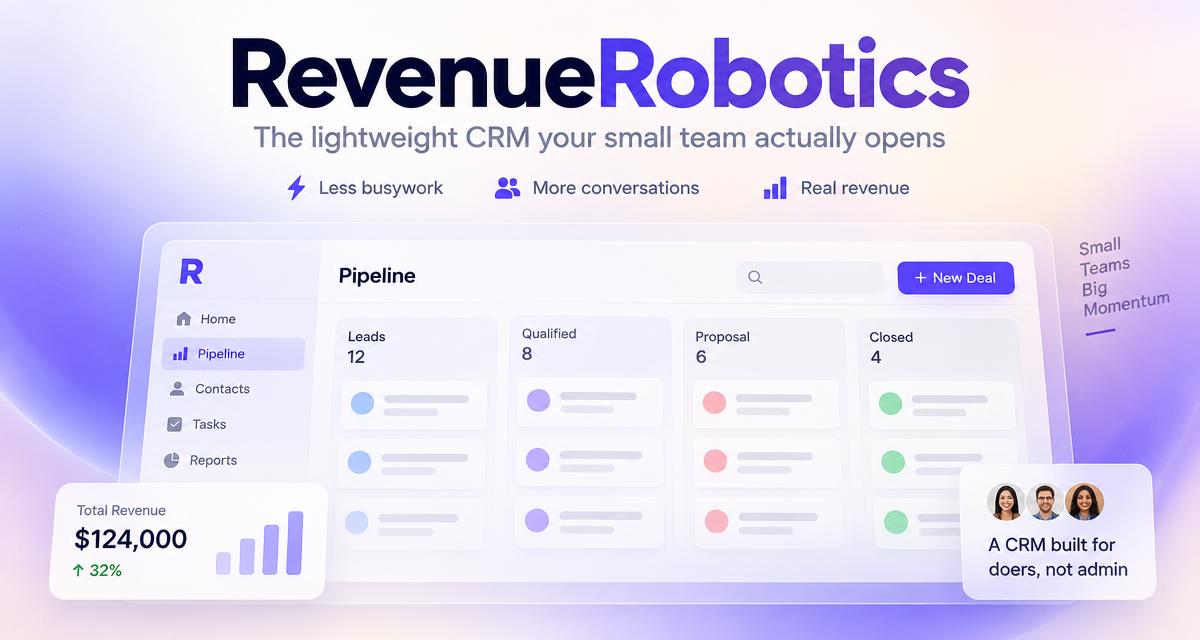
RevenueRobotics helps small teams manage deals, tasks, companies, notes, and follow-ups in one workspace. Instead of opening a CRM to see a static pipeline, teams can use it to see what needs action today.
A simple weekly review
Once a week, review every open deal and ask:
• Is there a clear next action?
• Does it have one owner?
• Is the action due soon?
• Has the prospect heard from us recently?
• Is anything blocked internally?
• Is the close date still realistic?
This can take 15 minutes for a small pipeline. The outcome is more valuable than a polished report: every important deal has a real next step.
Related product page
AI sales follow-up CRM →Try RevenueRobotics
Companies, deals, automations and AI note summaries in one calm CRM.
Start free trial