9 October 2026 · 3 min read
CEO Dashboard: What Founders Should See Every Morning
Learn what belongs on a CEO dashboard, how to use it each morning, and how to keep priorities, blockers, and revenue risks visible.
Overview
A CEO dashboard should not be a wall of charts.
It should answer one simple question:
What needs attention today?
For a founder, that usually means priorities, blockers, revenue risk, strategic relationships, and the work that cannot quietly slip another week. The best dashboard is not the one with the most metrics. It is the one that helps the CEO decide where to spend time.
What a CEO dashboard should show
A useful CEO dashboard usually includes five things:
• Top company priorities.
• Open decisions.
• Revenue risks.
• Blocked work.
• Important follow-ups.
That is enough to create clarity without overwhelming the person using it.
The dashboard should make it obvious which items are urgent, which are waiting on someone else, and which ones may look fine but need attention before they become a bigger problem.
What founders often get wrong
Many dashboards are built like reporting tools rather than decision tools.
That creates a few common problems:
• Too many charts.
• Too much historical data.
• Not enough visibility into what needs action next.
• No connection between metrics and tasks.
• No clear owner for the work behind the numbers.
If a CEO sees a problem but has no clear next step, the dashboard is incomplete.
What to include
A strong CEO dashboard can be built around these sections:
Section — What it should answer
Priorities — What must move this week?
Decisions — What needs CEO input?
Revenue risk — Which deals or customers are slipping?
Blockers — What is stuck and why?
Follow-ups — What promised actions still need to happen?
This is especially useful in founder-led companies where the CEO is still close to sales, hiring, product, or customer conversations.
A simple weekly CEO review
Each morning, or at least once a week, the CEO should review:
1. The top three priorities.
2. Any overdue or blocked actions.
3. Important customer or deal follow-ups.
4. Decisions waiting on input.
5. Any revenue item that has gone quiet.
That review does not need to take long. The goal is not to inspect everything. The goal is to catch the work that would otherwise disappear.
Where RevenueRobotics fits
RevenueRobotics is built for this kind of daily clarity.
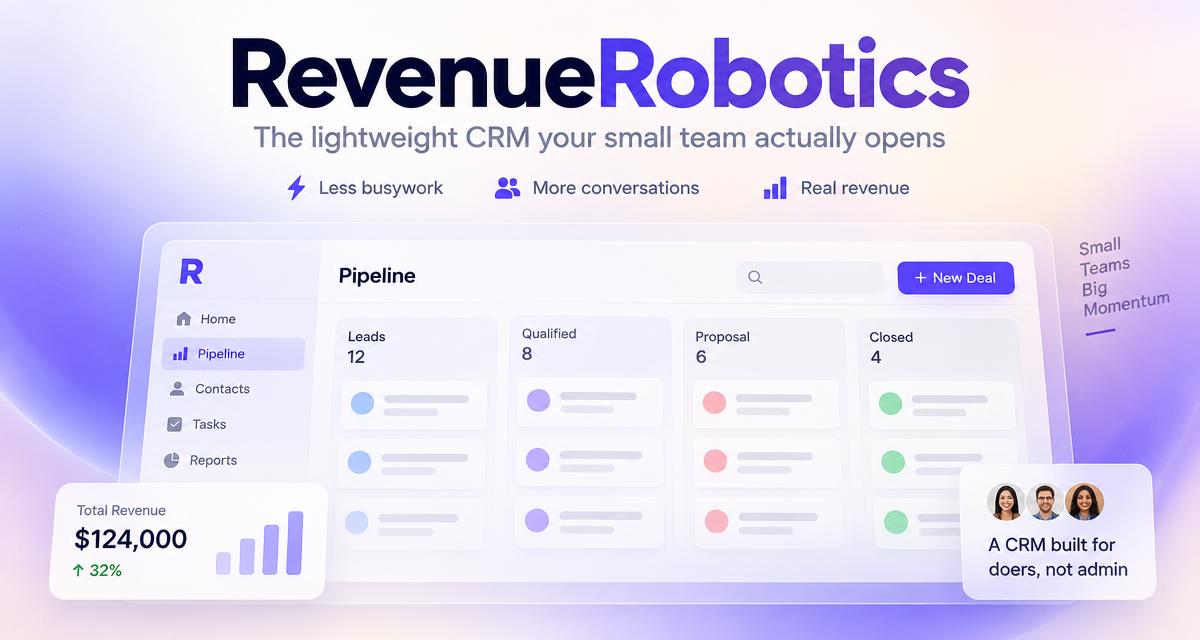
Instead of making the CEO jump between a CRM, notes, tasks, and spreadsheets, it gives a focused view of deals, priorities, tasks, and next actions. That makes it easier to see what needs attention and what should happen next.
For a founder, that matters more than having more reports.
Related product page
CRM for startups →Try RevenueRobotics
Companies, deals, automations and AI note summaries in one calm CRM.
Start free trial