8 October 2026 · 3 min read
Weekly Sales Pipeline Review Template for Founder-Led Teams
Use this weekly sales pipeline review template to spot stalled deals, confirm next actions, and keep founder-led sales moving.
Overview
A founder-led sales pipeline does not need a long Monday meeting.
It needs a consistent review that answers:
> Which deals can move this week, and what is stopping the others?
A weekly pipeline review helps founders avoid two common problems: spending too much time on inactive deals and forgetting the follow-ups that matter most.
The 20-minute pipeline review
Use this structure once a week.
### 1. Review new opportunities
Ask:
• Does this lead match the ideal customer profile?
• What problem are they trying to solve?
• Is there a real reason to act now?
• What is the next conversation or action?
If there is no clear next step, do not move the lead forward simply because they showed interest.
### 2. Review active deals
For every active deal, confirm:
• The decision-maker or buying group.
• The problem the customer wants to solve.
• The current deal stage.
• The last interaction.
• The next action.
• The action owner.
• The date it is due.
• Any blocker or internal dependency.
A deal that has no next action should be marked as at risk or moved to a nurture stage.
### 3. Review stalled opportunities
A deal may be stalled when:
• The prospect has not responded after a reasonable number of relevant follow-ups.
• The next meeting has not been scheduled.
• The buying process is unclear.
• The proposed close date keeps moving.
• Internal work is waiting without an owner.
• The team cannot explain what needs to happen next.
Do not leave stalled deals untouched because they look useful in a forecast. Mark them clearly and decide whether to re-engage, nurture, or close them out.
### 4. Review revenue risks
Look for:
• High-value deals with no upcoming meeting.
• Opportunities waiting on pricing, legal, security, or product input.
• Deals where the CEO promised a follow-up.
• Prospects with a decision deadline this month.
• Renewals or customers requiring executive attention.
This is where a task-led CRM is useful: the team can see the deal and the work needed to move it at the same time.
Copy-and-use template
Deal — Stage — Value — Last interaction — Next action — Owner — Due date — Risk or blocker
--- — --- — ---: — --- — --- — --- — --- — ---
[Company] — Discovery — [Value] — [Date] — [Specific action] — [Name] — [Date] — [Blocker]
[Company] — Proposal — [Value] — [Date] — [Specific action] — [Name] — [Date] — [Blocker]
[Company] — Negotiation — [Value] — [Date] — [Specific action] — [Name] — [Date] — [Blocker]
Keep it simple. The point is to make decisions, not build an elaborate report.
Questions to ask about every important deal
• What changed since last week?
• What does the customer expect next?
• Who owns that next action?
• Is there a scheduled date?
• What could prevent the deal from moving?
• Does the deal still belong in this stage?
• What help is needed from the founder or leadership team?
What a successful review produces
By the end of the meeting, every meaningful deal should have:
• A clear stage.
• A named owner.
• A specific next action.
• A due date.
• A visible blocker, if one exists.
• A realistic view of its likelihood and timing.
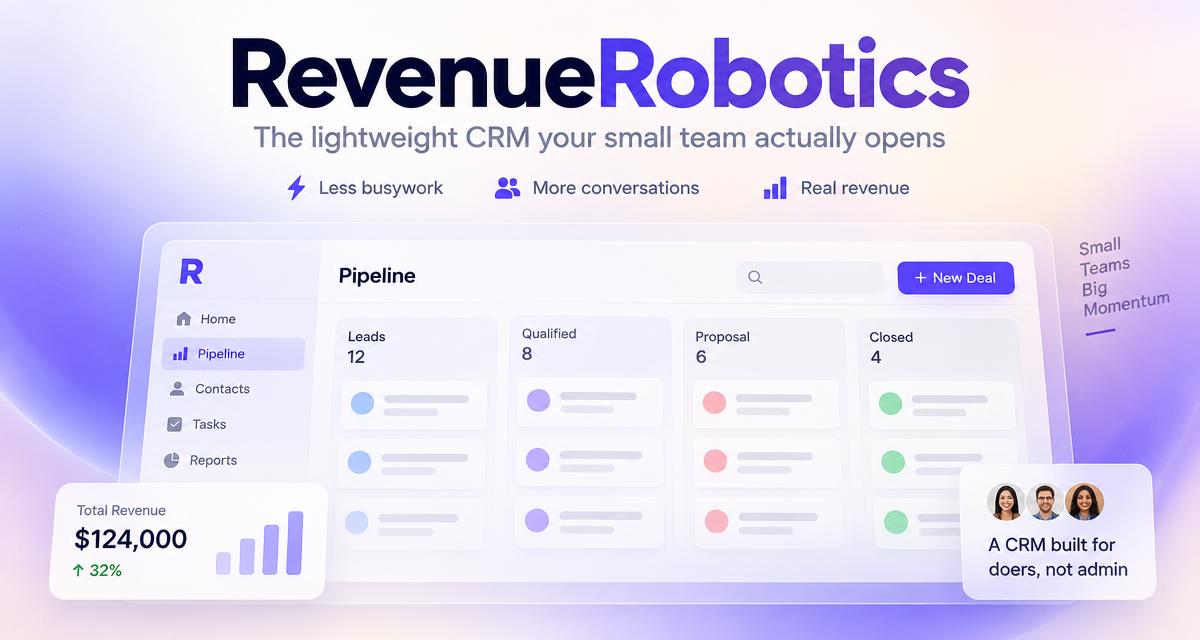
RevenueRobotics helps founder-led teams run this review from a live workspace where deals, follow-ups, tasks, and company context are connected.
Related product page
Sales forecasting for startups →Try RevenueRobotics
Companies, deals, automations and AI note summaries in one calm CRM.
Start free trial