8 October 2026 · 3 min read
CRM for a Two-Person Sales Team: A Practical Buying Guide
Learn what a two-person sales team needs from a CRM, which features matter, and how to choose a tool without creating extra admin work.
Overview
A two-person sales team does not need enterprise software.
It needs enough structure to stop customer details, follow-ups, and deal decisions from living in two people’s heads.
The right CRM should reduce admin and make it clear which deal needs attention next.
What a two-person sales team needs
The basics matter more than a long feature list.
Look for a CRM that can handle:
• Companies and contacts.
• A simple deal pipeline.
• Notes from calls and customer conversations.
• Tasks and follow-up reminders.
• Clear ownership for every deal.
• A daily view of work that needs attention.
• Easy import from a spreadsheet.
• Simple reporting on pipeline and deal stages.
• Affordable pricing without complex plan upgrades.
The goal is not to copy a larger sales organisation. It is to give two people a shared memory and a shared process.
The best workflow for two people
A practical sales process can be simple:
1. Create a company and contact record after the first meaningful conversation.
2. Create a deal only when there is a relevant problem and a possible buying process.
3. Record notes immediately after calls.
4. Create the next action before ending the work session.
5. Assign a single owner for each deal and task.
6. Review the pipeline together once a week.
7. Mark stalled or poor-fit deals accurately.
This prevents duplicated outreach, missed commitments, and uncertainty about who is responsible.
Features that often create unnecessary complexity
Two-person teams should be careful with tools that require significant setup before they become useful.
You may not need:
• Multiple sales territories.
• Complex approval chains.
• Detailed commission management.
• Advanced permission structures.
• Large-scale lead-routing rules.
• Extensive custom objects.
• Forecasting processes built for dozens of reps.
Those may become useful later. Early on, a complex system can become a second job.
Questions to ask before buying
• Can both people see the same company, deal, notes, and next step?
• Does the system make overdue follow-ups obvious?
• Can a spreadsheet be imported quickly?
• Can each deal have one owner?
• Does it work well without a dedicated sales-operations person?
• Does pricing remain understandable as the team grows?
• Will both people realistically update it after every customer interaction?
If the answer to the final question is no, the CRM will not solve the problem.
Why task management matters
For a two-person team, the CRM is not simply a database.
It is the handoff system.
One person may run the first call while the other sends the proposal. One person may manage the relationship while the other answers technical questions. Without linked tasks, both people can assume the other person is handling the next step.
A CRM with task management makes those responsibilities visible.
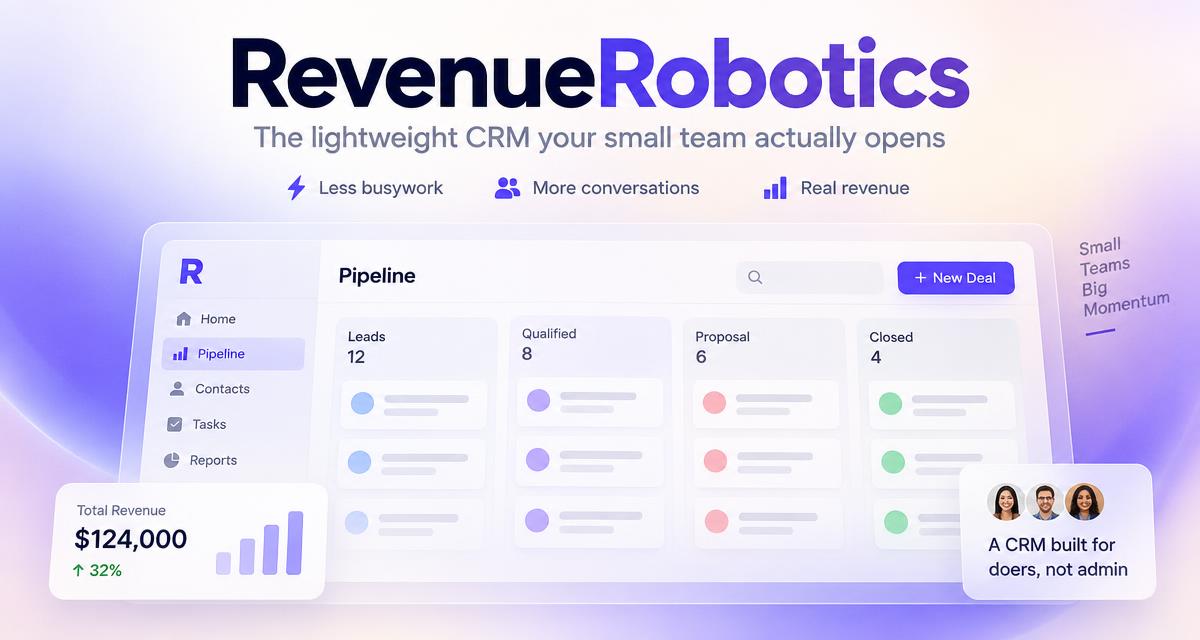
RevenueRobotics brings deals, companies, tasks, follow-ups, and prioritised work into one workspace. It is designed for small teams that need clarity without the operational overhead of an enterprise CRM.
Related product page
CRM for startups →Try RevenueRobotics
Companies, deals, automations and AI note summaries in one calm CRM.
Start free trial